GeneSpect Reporterfor Inherited and
Rare Disorders
Complete germline interpretation across the full scope of inherited and rare disorders - from complex variant identification to actionable findings.
Resolving germline complexity demandsmore than a single answer
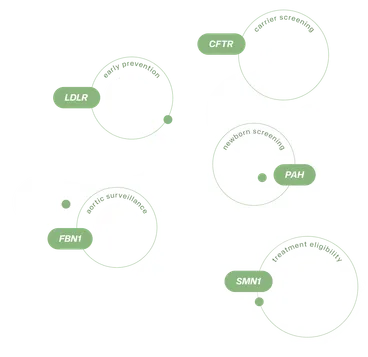
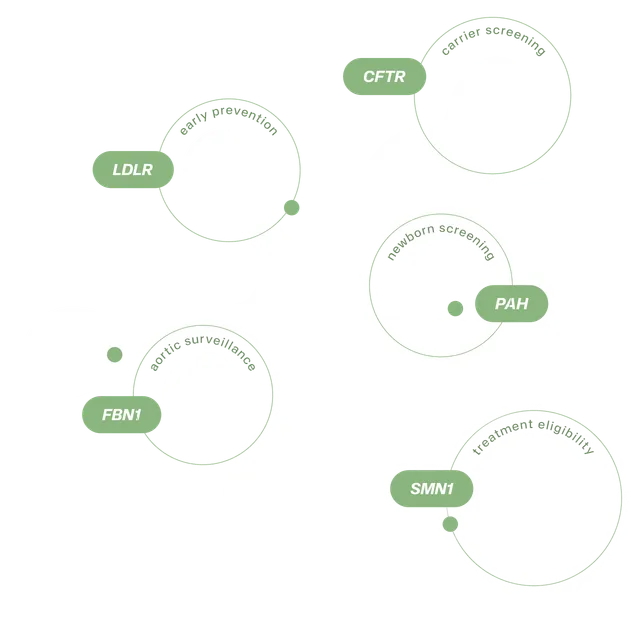
Every germline case presents a distinct clinical puzzle. Resolving complex phenotypes, interpreting intricate inheritance patterns, and weighing variant evidence often requires balancing multiple fragmented pipelines. GeneSpect Hereditary Reporter consolidates these needs into a single validated workflow, dynamically adjusting analytical depth to match any indication
'%3e%3cg%20id='Vector'%3e%3c/g%3e%3cg%20id='Group%201547765320'%3e%3cpath%20id='Vector_2'%20d='M28.0008%2075.3318L56.1566%2027.694'%20stroke='white'%20stroke-width='1.5'%20stroke-linecap='round'%20stroke-linejoin='round'/%3e%3cpath%20id='Vector_3'%20d='M94.5384%2077.2497L66.1301%2027.694'%20stroke='white'%20stroke-width='1.5'%20stroke-linecap='round'%20stroke-linejoin='round'/%3e%3cpath%20id='Vector_4'%20d='M89.525%2085.1871L35.9997%2085.187'%20stroke='white'%20stroke-width='1.5'%20stroke-linecap='round'%20stroke-linejoin='round'/%3e%3cpath%20id='Vector_5'%20d='M69.2776%2021.1718C69.2776%2019.0925%2068.4516%2017.0984%2066.9813%2015.6281C65.511%2014.1578%2063.5168%2013.3318%2061.4375%2013.3318C59.3582%2013.3318%2057.3641%2014.1578%2055.8938%2015.6281C54.4235%2017.0984%2053.5975%2019.0925%2053.5975%2021.1718C53.5975%2023.2511%2054.4235%2025.2453%2055.8938%2026.7156C57.3641%2028.1859%2059.3582%2029.0119%2061.4375%2029.0119C63.5168%2029.0119%2065.511%2028.1859%2066.9813%2026.7156C68.4516%2025.2453%2069.2776%2023.2511%2069.2776%2021.1718Z'%20stroke='white'%20stroke-width='1.5'%20stroke-linecap='round'%20stroke-linejoin='round'/%3e%3cpath%20id='Vector_6'%20d='M89.5243%2084.6719C89.5243%2082.5926%2090.3503%2080.5985%2091.8206%2079.1282C93.2909%2077.6579%2095.285%2076.8319%2097.3644%2076.8319C99.4437%2076.8319%20101.438%2077.6579%20102.908%2079.1282C104.378%2080.5985%20105.204%2082.5926%20105.204%2084.6719C105.204%2086.7512%20104.378%2088.7454%20102.908%2090.2157C101.438%2091.686%2099.4437%2092.512%2097.3644%2092.512C95.285%2092.512%2093.2909%2091.686%2091.8206%2090.2157C90.3503%2088.7454%2089.5243%2086.7512%2089.5243%2084.6719Z'%20stroke='white'%20stroke-width='1.5'%20stroke-linecap='round'%20stroke-linejoin='round'/%3e%3cpath%20id='Vector_7'%20d='M36%2085.3318C36%2082.6796%2034.9464%2080.1361%2033.0711%2078.2607C31.1957%2076.3854%2028.6522%2075.3318%2026%2075.3318C23.3478%2075.3318%2020.8043%2076.3854%2018.9289%2078.2607C17.0536%2080.1361%2016%2082.6796%2016%2085.3318C16%2087.984%2017.0536%2090.5275%2018.9289%2092.4029C20.8043%2094.2782%2023.3478%2095.3318%2026%2095.3318C28.6522%2095.3318%2031.1957%2094.2782%2033.0711%2092.4029C34.9464%2090.5275%2036%2087.984%2036%2085.3318Z'%20stroke='%23C3FFB1'%20stroke-width='1.5'%20stroke-linecap='round'%20stroke-linejoin='round'/%3e%3cpath%20id='Vector_8'%20d='M32%2085.3318C32%2083.7405%2031.3679%2082.2144%2030.2426%2081.0891C29.1174%2079.9639%2027.5913%2079.3318%2026%2079.3318C24.4087%2079.3318%2022.8826%2079.9639%2021.7574%2081.0891C20.6321%2082.2144%2020%2083.7405%2020%2085.3318C20%2086.9231%2020.6321%2088.4492%2021.7574%2089.5744C22.8826%2090.6996%2024.4087%2091.3318%2026%2091.3318C27.5913%2091.3318%2029.1174%2090.6996%2030.2426%2089.5744C31.3679%2088.4492%2032%2086.9231%2032%2085.3318Z'%20fill='%23C3FFB1'%20stroke='%23C3FFB1'%20stroke-width='1.5'%20stroke-linecap='round'%20stroke-linejoin='round'/%3e%3c/g%3e%3c/g%3e%3cdefs%3e%3cclipPath%20id='clip0_0_38'%3e%3crect%20width='122'%20height='122'%20fill='white'/%3e%3c/clipPath%3e%3c/defs%3e%3c/svg%3e)
Rare disease
Phenotype-driven investigations for WES and WGS data where the causal gene is unknown. ExploRare resolves the phenotypes into ranked disease candidates, while VarMatch scores every variant against HPO terms, inheritance, and evidence - delivering a prioritized shortlist ready for final review.
'%3e%3cg%20id='Vector'%3e%3c/g%3e%3cg%20id='Group%201547765320'%3e%3cpath%20id='Line%207'%20d='M20.1945%2065.9189C20.4874%2066.2118%2020.9623%2066.2118%2021.2551%2065.9189L26.0281%2061.1459C26.321%2060.8531%2026.321%2060.3782%2026.0281%2060.0853C25.7352%2059.7924%2025.2604%2059.7924%2024.9675%2060.0853L20.7248%2064.3279L16.4822%2060.0853C16.1893%2059.7924%2015.7144%2059.7924%2015.4215%2060.0853C15.1286%2060.3782%2015.1286%2060.8531%2015.4215%2061.1459L20.1945%2065.9189ZM31.7248%2029.7751V30.5251H48.1858V29.7751V29.0251H31.7248V29.7751ZM20.7248%2040.7751H19.9748V65.3886H20.7248H21.4748V40.7751H20.7248ZM31.7248%2029.7751V29.0251C25.2355%2029.0251%2019.9748%2034.2857%2019.9748%2040.7751H20.7248H21.4748C21.4748%2035.1141%2026.0639%2030.5251%2031.7248%2030.5251V29.7751Z'%20fill='white'/%3e%3cpath%20id='Line%208'%20d='M101.922%2070.2097C101.629%2070.5026%20101.154%2070.5026%20100.861%2070.2097L96.0883%2065.4367C95.7954%2065.1438%2095.7954%2064.669%2096.0883%2064.3761C96.3812%2064.0832%2096.8561%2064.0832%2097.149%2064.3761L101.392%2068.6187L105.634%2064.3761C105.927%2064.0832%20106.402%2064.0832%20106.695%2064.3761C106.988%2064.669%20106.988%2065.1438%20106.695%2065.4367L101.922%2070.2097ZM90.3916%2029.7751V30.5251H73.9306V29.7751V29.0251H90.3916V29.7751ZM101.392%2040.7751H102.142V69.6794H101.392H100.642V40.7751H101.392ZM90.3916%2029.7751V29.0251C96.8809%2029.0251%20102.142%2034.2857%20102.142%2040.7751H101.392H100.642C100.642%2035.1141%2096.0525%2030.5251%2090.3916%2030.5251V29.7751Z'%20fill='white'/%3e%3cpath%20id='Line%209'%20d='M61.5885%2086.5147C61.2956%2086.8076%2060.8208%2086.8076%2060.5279%2086.5147L55.7549%2081.7417C55.462%2081.4488%2055.462%2080.9739%2055.7549%2080.6811C56.0478%2080.3882%2056.5227%2080.3882%2056.8156%2080.6811L61.0582%2084.9237L65.3008%2080.6811C65.5937%2080.3882%2066.0686%2080.3882%2066.3615%2080.6811C66.6544%2080.9739%2066.6544%2081.4488%2066.3615%2081.7417L61.5885%2086.5147ZM61.0582%2043.0765H61.8082V85.9844H61.0582H60.3082V43.0765H61.0582Z'%20fill='white'/%3e%3cpath%20id='Vector_2'%20d='M73.9306%2030.2041C73.9306%2026.7902%2072.5744%2023.516%2070.1603%2021.102C67.7463%2018.688%2064.4722%2017.3318%2061.0582%2017.3318C57.6442%2017.3318%2054.3701%2018.688%2051.9561%2021.102C49.542%2023.516%2048.1858%2026.7902%2048.1858%2030.2041C48.1858%2033.6181%2049.542%2036.8922%2051.9561%2039.3063C54.3701%2041.7203%2057.6442%2043.0765%2061.0582%2043.0765C64.4722%2043.0765%2067.7463%2041.7203%2070.1603%2039.3063C72.5744%2036.8922%2073.9306%2033.6181%2073.9306%2030.2041Z'%20stroke='%23B2E9A0'%20stroke-width='1.5'%20stroke-linecap='round'%20stroke-linejoin='round'/%3e%3cpath%20id='Vector_3'%20d='M69.4395%2096.6112C69.4395%2094.4756%2068.5912%2092.4274%2067.0811%2090.9173C65.5709%2089.4072%2063.5228%2088.5588%2061.3872%2088.5588C59.2515%2088.5588%2057.2034%2089.4072%2055.6933%2090.9173C54.1832%2092.4274%2053.3348%2094.4756%2053.3348%2096.6112C53.3348%2098.7468%2054.1832%20100.795%2055.6933%20102.305C57.2034%20103.815%2059.2515%20104.664%2061.3872%20104.664C63.5228%20104.664%2065.5709%20103.815%2067.0811%20102.305C68.5912%20100.795%2069.4395%2098.7468%2069.4395%2096.6112Z'%20stroke='%23C3FFB1'%20stroke-width='1.5'%20stroke-linecap='round'%20stroke-linejoin='round'/%3e%3cpath%20id='Vector_4'%20d='M93.6673%2081.1644C93.6673%2079.0288%2094.5157%2076.9806%2096.0258%2075.4705C97.5359%2073.9604%2099.584%2073.112%20101.72%2073.112C103.855%2073.112%20105.903%2073.9604%20107.414%2075.4705C108.924%2076.9806%20109.772%2079.0288%20109.772%2081.1644C109.772%2083.3%20108.924%2085.3481%20107.414%2086.8583C105.903%2088.3684%20103.855%2089.2167%20101.72%2089.2167C99.584%2089.2167%2097.5359%2088.3684%2096.0258%2086.8583C94.5157%2085.3481%2093.6673%2083.3%2093.6673%2081.1644Z'%20stroke='%23B2E9A0'%20stroke-width='1.5'%20stroke-linecap='round'%20stroke-linejoin='round'/%3e%3cpath%20id='Vector_5'%20d='M29.1062%2076.0154C29.1062%2073.8798%2028.2578%2071.8317%2026.7477%2070.3215C25.2376%2068.8114%2023.1894%2067.9631%2021.0538%2067.9631C18.9182%2067.9631%2016.87%2068.8114%2015.3599%2070.3215C13.8498%2071.8317%2013.0014%2073.8798%2013.0014%2076.0154C13.0014%2078.1511%2013.8498%2080.1992%2015.3599%2081.7093C16.87%2083.2194%2018.9182%2084.0678%2021.0538%2084.0678C23.1894%2084.0678%2025.2376%2083.2194%2026.7477%2081.7093C28.2578%2080.1992%2029.1062%2078.1511%2029.1062%2076.0154Z'%20stroke='%23B2E9A0'%20stroke-width='1.5'%20stroke-linecap='round'%20stroke-linejoin='round'/%3e%3c/g%3e%3c/g%3e%3cdefs%3e%3cclipPath%20id='clip0_0_28'%3e%3crect%20width='122'%20height='122'%20fill='white'/%3e%3c/clipPath%3e%3c/defs%3e%3c/svg%3e)
Inherited disorders
Targeted screening across custom and disease-oriented gene panels. Designed for defined indications, the workflow systematically isolates pathogenic and likely pathogenic variants across dominant, recessive, and X-linked traits for streamlined review.

Carrier status
Targeted carrier status analysis for recessive and X-linked conditions. Isolates single-allele variants in asymptomatic samples to clarify inherited risk for potential offspring.
Hereditary cancer
Focused germline analysis tailored to cancer susceptibility panels. Evaluates inherited variants across defined gene sets for major genetic tumor syndromes, matching findings directly to established syndrome management options.
One comprehensive germline workflow, from complex variant identificationto actionable shortlist.

SNVs, indels & non-coding variants
Substitutions, insertions and deletions across coding regions, splice sites and deep-intronic positions.

Structural events
Copy-number variants and short tandem repeat expansions detected within the same workflow, each classified against a dedicated ACMG criterion set.

Mitochondrial variants
Variants across the mitochondrial genome with heteroplasmy quantified per call.

Phenotype-driven prioritization
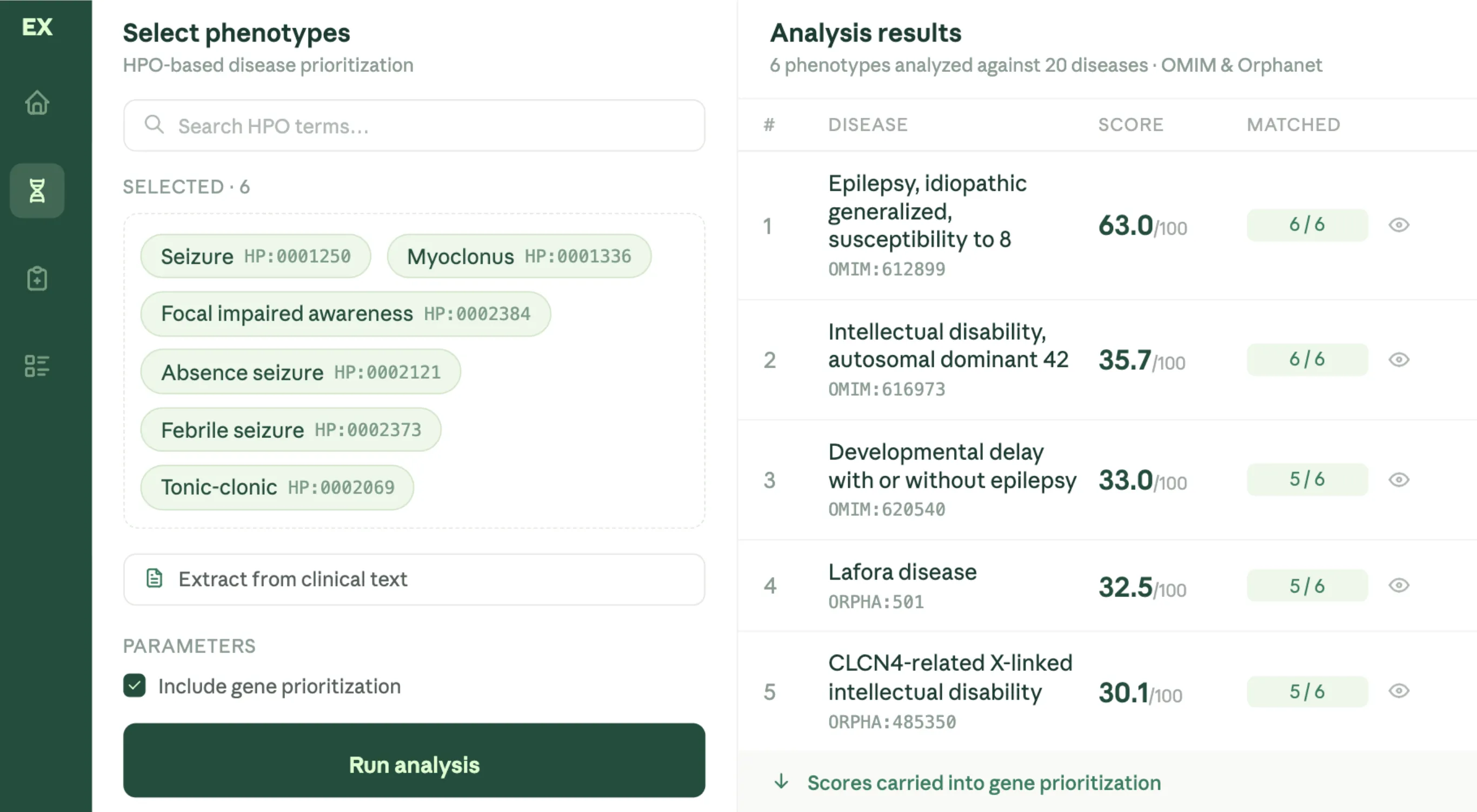
HPO terms and free-text descriptions are resolved through the proprietary ExploRare algorithm and matched to diseases in OMIM and Orphanet, with scores carried into gene prioritization.

Pedigree-based analysis
Proband, duo and trio modes supported, with kinship assessment and inheritance resolution across the parental samples available.
'%20stroke='%230A4037'%20stroke-width='1.5'/%3e%3cline%20id='Line%2029'%20x1='17.1094'%20y1='12.9687'%20x2='30.6032'%20y2='12.9687'%20stroke='%230A4037'%20stroke-width='1.5'/%3e%3cline%20id='Line%2032'%20y1='-0.75'%20x2='13.4938'%20y2='-0.75'%20transform='matrix(1%208.74228e-08%208.74228e-08%20-1%2017.1094%2033.6384)'%20stroke='%230A4037'%20stroke-width='1.5'/%3e%3cline%20id='Line%2033'%20y1='-0.75'%20x2='9.63845'%20y2='-0.75'%20transform='matrix(1%20-8.74228e-08%20-8.74228e-08%20-1%2019.0391%2029.1404)'%20stroke='%230A4037'%20stroke-width='1.5'/%3e%3cpath%20id='Vector%2088'%20d='M15.8203%2041.0278C15.8203%2023.9999%2031.8844%2022.7147%2031.8844%206.97192'%20stroke='%23B2E9A0'%20stroke-width='1.5'%20stroke-linecap='round'/%3e%3cpath%20id='Vector%2089'%20d='M31.8906%2041.0278C31.8906%2033.0282%2028.3452%2028.5031%2024.5855%2024.3211M15.8265%206.97192C15.8265%2014.3657%2019.37%2018.5704%2023.1284%2022.7147'%20stroke='%236798DE'%20stroke-width='1.5'%20stroke-linecap='round'/%3e%3c/g%3e%3cg%20id='Group%201547765235'%3e%3cpath%20id='Vector%2088_2'%20d='M33.0859%2030.8584C33.0859%2022.9357%2040.5602%2022.3377%2040.5602%2015.0129'%20stroke='%236798DE'%20stroke-width='1.5'%20stroke-linecap='round'/%3e%3cpath%20id='Vector%2089_2'%20d='M40.5625%2030.8584C40.5625%2027.1363%2038.9129%2025.0309%2037.1636%2023.0851M33.0882%2015.0129C33.0882%2018.4531%2034.7369%2020.4095%2036.4857%2022.3377'%20stroke='%236798DE'%20stroke-width='1.5'%20stroke-linecap='round'/%3e%3c/g%3e%3cg%20id='Group%201547765236_2'%3e%3cpath%20id='Vector%2088_3'%20d='M7.24219%2030.8584C7.24219%2022.9357%2014.7164%2022.3377%2014.7164%2015.0129'%20stroke='%23B2E9A0'%20stroke-width='1.5'%20stroke-linecap='round'/%3e%3cpath%20id='Vector%2089_3'%20d='M14.7188%2030.8584C14.7188%2027.1363%2013.0691%2025.0309%2011.3199%2023.0851M7.24449%2015.0129C7.24449%2018.4531%208.89318%2020.4095%2010.6419%2022.3377'%20stroke='%23B2E9A0'%20stroke-width='1.5'%20stroke-linecap='round'/%3e%3c/g%3e%3c/g%3e%3c/g%3e%3c/svg%3e)
Compound heterozygosity
Two hits on the same gene resolved as in cis or in trans, using parental sequencing where available.

De novo variant detection
Variants present in the proband but absent from both parents, identified through trio analysis.

Evidence-based prioritization
VarMatch weighs phenotype, gene–disease evidence, inheritance and ACMG into one ranked shortlist.
Guided variant prioritization
Structured phenotypes, prioritized variants, actionable findings - in one workflow.
Phenotype resolution through ExploRare
Translating a clinical presentation into a genomic search is one of the least precise steps in germline analysis. Descriptions rarely reduce to a single ontology term, and the same presentation is often consistent with a broad set of candidate diseases. ExploRare addresses this by normalizing HPO terms and free-text input into a structured phenotypic profile, matched against disease associations from OMIM and Orphanet. Each candidate disease receives a match score, which is propagated to the associated genes. Variants in those genes carry the same weight into prioritization, making phenotypic evidence an intrinsic component of the ranking process.
From Millions of Variants to a Prioritized Shortlist
VarMatch is a proprietary variant prioritization algorithm designed to transform complex genomic datasets into a structured, prioritized review list. By evaluating every variant through multi-layered scoring - combining quality controls, population frequency, inheritance models, and HPO phenotype matching - it instantly surfaces the highest-priority candidates most likely to explain the case, while keeping the complete set of identified variants fully transparent and accessible throughout.
All called variants
184,720
Quality and population frequency
3,420
Instance and sgregation
612
Phenotype amd gene-disease
47
Top 20 candidates
VarMatch places the twenty highest-scoring candidates at the head of the review, indicating where analytical attention is best directed first. The complete variant set remains accessible throughout.
Actionable Secondary Findings on Demand
Maximize the value of every genomic sample by identifying high-impact, medically actionable risks beyond the primary indication. The GeneSpect Hereditary Reporter enables seamless opt-in to secondary variant screening during any run, automatically evaluating data against the latest ACMG Secondary Findings gene list to deliver comprehensive insights without requiring separate re-analysis.
ACMG Secondary Findings
Secondary findings unrelated to the primary diagnostic indication were evaluated according to the current ACMG recommendations (ACMG v3.3 list of actionable genes).
BRCA2
NM_000059.4:c.36dup (p.Glu13Ter)
Heterozygous
52.7%
Pathogenic
Pathogenic
Every finding, its evidence and its context - in one workspace.
All findings are delivered to VariantMINER for further manual review - the workspace where each step of the analysis converges. Every ranked candidate arrives with its ACMG classification, its evidence and its inheritance context. Reviewers can refine the phenotype, update HPO terms, reclassify variants and confirm or exclude findings, with each change recorded and carried through to the final report.
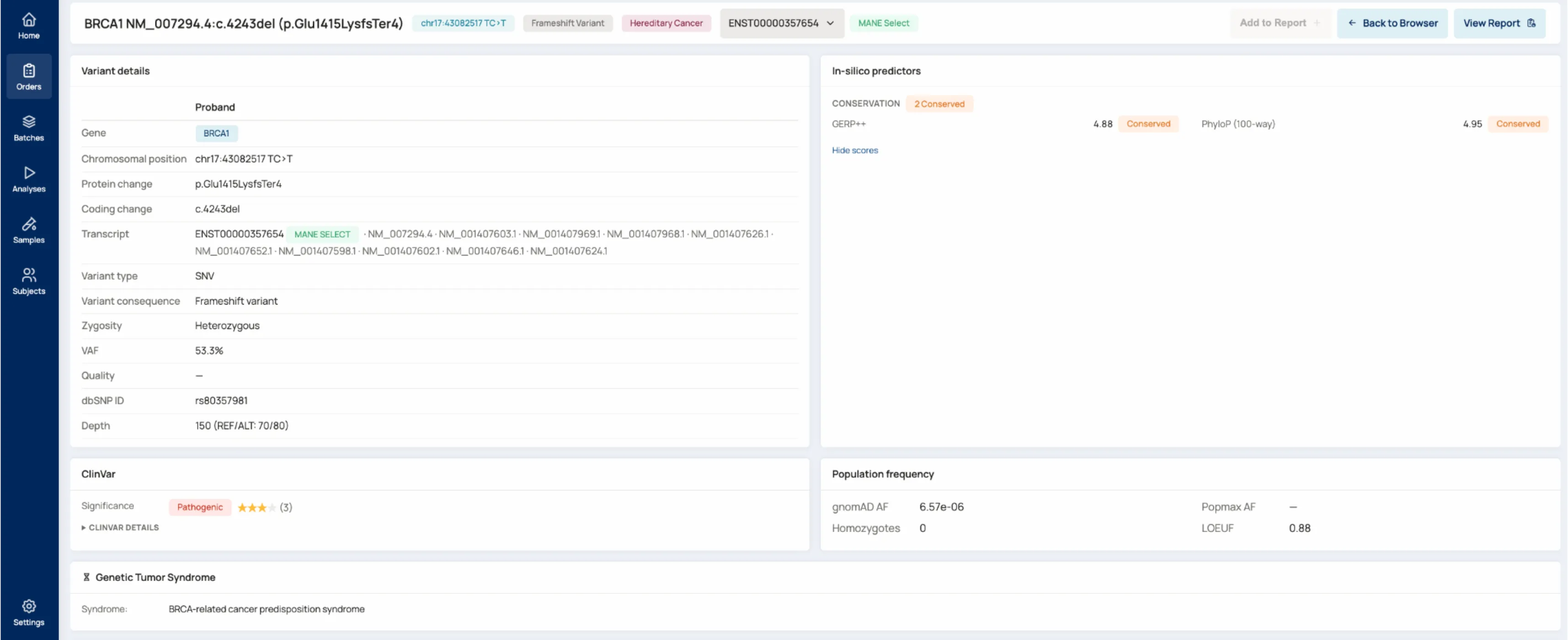
Full access to the Top 20 shortlist and every remaining variant, with the analytical context of each preserved
Phenotype and HPO terms updated on demand, without a full re-run
Automated ACMG classification supplemented with reviewer-supplied criteria
Every action recorded, with a complete audit trail behind each decision


See how GeneSpect Hereditary Reporter can simplify analysis and reporting for your laboratory.
GeneSpect HereditaryReporter Resources
View all News
NewsIntelliseq & Manifold Partnership - AI-Ready Genomics and Scalable NGS Interpretation
Intelliseq has partnered with Manifold, an AI platform for life sciences enabling organizations to work with complex, multimodal data in a secure, governed environment. As genomic data volumes continue to grow, the key challenge is no longer sequencing - but interpretation. Tertiary analysis, includ
- News
Intelliseq at ACMG Annual Clinical Genetics Meeting 2026
Intelliseq will be exhibiting at the ACMG Annual Clinical Genetics Meeting 2026, taking place on March 11–13, 2026, in Baltimore, USA. During the conference, our team will present GeneSpect solutions designed to support genomic data interpretation in clinical and research settings. Visitors will hav
- Webinar
From NGS Chaos to Actionable Insights: Streamlining Somatic Variant Interpretation with GeneSpect Somatic Reporter
Next-generation sequencing has transformed oncology diagnostics, but interpreting the growing volume of somatic variants remains a significant challenge for clinical laboratories. Fragmented annotation sources, evolving AMP/ACMG guidelines, and manual workflows can slow report sign-out and introduce
- News
Hospital for Special Surgery Engages Intelliseq to Support Genomics-Driven Orthopedic Research
Hospital for Special Surgery (HSS), the world’s leading academic medical center focused on musculoskeletal health, has engaged Intelliseq, a genomic data science company specializing in large scale biological data analysis, to provide genomic sequencing and analytical services in support of an HSS l
 Webinar
Advancing Rare Disease Genomics - Optimizing Phenotype-Driven Variant Prioritization with the GeneSpect Hereditary Reporter
Webinar Whole exome sequencing (WES) and whole genome sequencing (WGS) have become the standard first-line genetic tests in patients with suspected rare diseases. They enable comprehensive detection of diagnostic variants across the coding and non-coding genome, significantly expanding the scope of
- News
Intelliseq Talk at LIMR - From Variant Calling to Functional Insights
We had the privilege of delivering our talk “Genomic workflows: From variant calling to functional insights in cardiovascular applications” at the Lankenau Institute for Medical Research (LIMR), thanks to the invitation extended by Dr. Héctor Barajas-Martínez. The presentation explored how modern ge

Sep 03, 2026
Case studyFrom exome data to molecular diagnosis - automated tertiary analysis in hereditary hearing loss
In a University of Kentucky pilot study, iFlow's automated tertiary analysis matched expert review in diagnosing hereditary hearing loss, cutting manual interpretation time.

Mar 09, 2026
NewsIntelliseq at AACR Annual Meeting 2026
Intelliseq will exhibit at the AACR Annual Meeting 2026 in San Diego, presenting GeneSpect Reporters for genomic data interpretation and reporting.